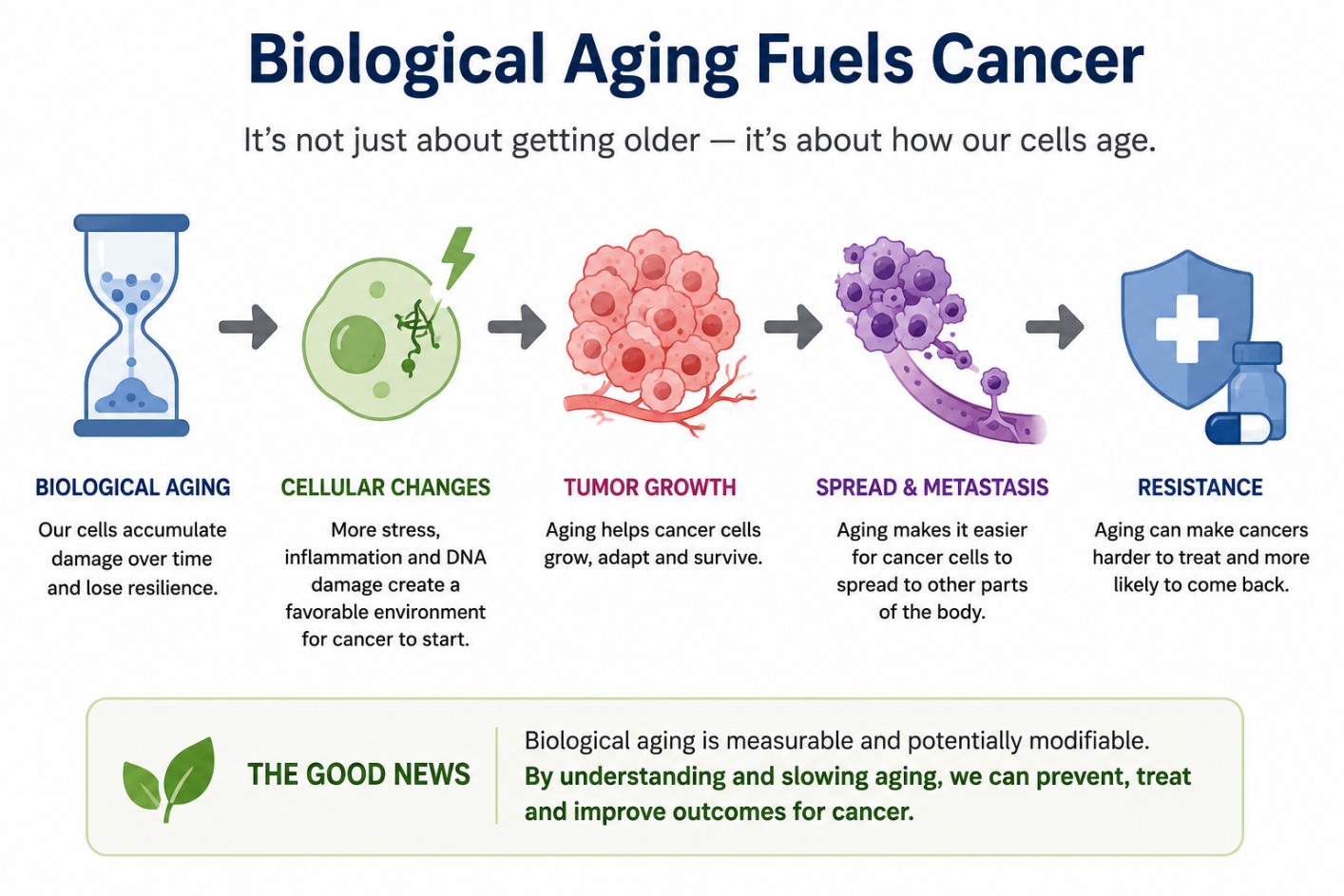
For decades, age has been recognized as one of the strongest risk factors for cancer. But a series of groundbreaking studies published in 2026 suggest that it’s not simply how many birthdays we’ve celebrated—it may be how fast our cells and tissues are biologically aging.
Unlike chronological age, biological age reflects the cumulative effects of molecular damage, chronic inflammation, metabolic dysfunction, oxidative stress, and declining tissue resilience. Importantly, not everyone ages at the same pace.
Exciting new discoveries are now revealing that accelerated biological aging can:
🔬 Increase the risk of developing cancer, including lung cancer (Tian et al., Nature Medicine, 2026; Ding et al., Nature Medicine, 2026).
🫁 Leave detectable molecular “aging signatures” in lung cells that may predict cancer years before diagnosis, opening new opportunities for early detection and personalized prevention (Ding et al., Nature Medicine, 2026).
🚀 Make tumors more aggressive by activating cellular stress-response pathways that enhance survival, metabolic adaptation, and metastatic spread. A landmark study demonstrated that aging rewires lung cancer cells through activation of the ATF4-mediated Integrated Stress Response, dramatically increasing their metastatic potential (Patel et al., Nature, 2026).
⚡ Reprogram metabolism, inflammation, and immune function, creating an environment that supports cancer initiation, progression, and treatment resistance (Patel et al., Nature, 2026; Tian et al., Nature Medicine, 2026).
These discoveries challenge the traditional view of aging as simply a background risk factor. Instead, biological aging is emerging as an active driver of cancer biology.
Imagine what this could mean.
If we can accurately measure biological age, we may be able to:
✅ identify individuals at highest cancer risk,
✅ detect cancer earlier,
✅ predict disease aggressiveness,
✅ personalize treatment strategies,
✅ prevent metastasis, and perhaps even
✅ develop therapies that target the aging process itself.
The convergence of aging biology, cancer biology, metabolism, immunology, and precision medicine is opening one of the most exciting frontiers in biomedical research. Understanding why some tissues age faster than others may become just as important as understanding why cancers arise.
Rather than viewing aging as inevitable, we may soon begin to measure it, understand it, and ultimately intervene in it—transforming the way we prevent and treat cancer.